
If you are a hunter, bird watcher, or stargazer, you will definitely need an optic device to help you watch objects and animals that are far away. While your main options will be binoculars or spotting scope, deciding between the two is not easy.
These two optic devices serve the same purpose. However, there are certain aspects that make each of them ideal for different users and applications. We will go through the similarities and differences, advantages and downsides for each of them to help you make the choice.
What are Binoculars and Spotting Scopes
Spotting Scopes and Binoculars are optic devices made to help users see objects and animals that are far away.
Binoculars:
Binoculars have two telescopes one for each eye and are divided into porro prism binoculars and roof prism binoculars.
The other classification of binoculars is according to their application, for instance marine binoculars, night vision binoculars and astrology binoculars.
Spotting Scope:
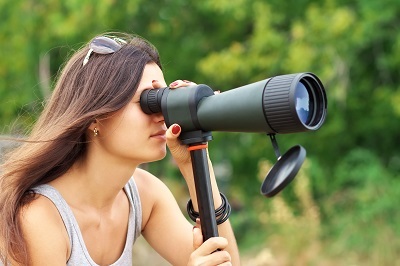
Spotting scope, also known as a digiscope or field scope, is a compact telescope with just one eye view.
In terms of magnification, spotting scopes have a higher magnification than binoculars, but falls below a telescope. Mono-Scope and spotting scopes look very similar. Just like binoculars, spotting scopes are used for hunting, birding, wildlife watching and surveillance among others.
From the surface level, these two optic devices are very similar. However, it’s not until you check the nitty gritties that you will see their differences.
Compare different aspects of Binoculars and Spotting Scope to see how they differ.
| Binoculars | Spotting Scopes | |
| Magnification | 4x to 25x | 11x to 100x |
| Portability | Very portable | Hard to carry around |
| Zoom power | Limited zoom power | Better zoom power |
| Tripod | Don’t require a tripod | Supposed to be mounted on a tripod |
| Field of view | Larger field of view | Smaller field of view |
| Digiscoping | Only high end models allow digiscoping | Easy to connect to a digital camera |
| Hiking | The best for hiking, trekking and backpacking | Not ideal for hiking, trekking and backpacking |
.
1. Magnification Power: Binocular vs Spotting Scope
The first major difference between a spotting scope and binoculars is the magnification power. Spotting scopes have magnification power ranging between 10x and 60x, while most binoculars have a magnification power ranging between 6x and 10x. However, there are a few high quality binoculars with 15x to 100x magnification.
Magnification refers to how big the object will appear. For instance a 10x magnification on binoculars means that the object will appear x10 bigger than how it’d appear if you were using your naked eyes. So, an object that is 100m away will appear as if its 10m away.
While a higher magnification means clearer images and intricate details, there is a limit depending on the atmosphere conditions. High humidity levels dust, air currents, wind and heat waves, affect the image quality. You will only utilize the high magnification levels during dry climates and in high altitudes.
Magnification power winner: spotting scope
2. Portability of Spotting Scope and Binoculars
When it comes to portability, binoculars are designed to be more portable. They are lightweight and have a strap, allowing you to wear them around your neck. Also, there are some models that you can carry in your pocket. However, most binoculars with above 15x magnification are a bit heavier and are supposed to be mounted on a tripod.
Spotting scopes are bigger, longer and heavier and are supposed to be mounted on a tripod. Just like big binoculars, big spotting scopes are cumbersome and less compact. The need for a tripod makes it even harder to carry them around. Note, there are a few models that are compact and lightweight and don’t require mounting.
For most people, the choice between binoculars and a spotting scope comes down to portability. Even if spotting scopes have a higher magnification, carrying them around is a challenge unless you have a spotting partner. If you are all alone you are better off with a high magnification binocular.
Despite being cumbersome, spotting scopes are especially great when hunting mountain sheep. A spotting scope will make it easy to assess if your target is legal and also confirm other details such as the type, sex and age.
Looking for the most portable and easy-to-set-up optic device for hunting, bird watching or animal watching, go with a pair of binoculars. However, if portability is not an issue go with a spotting scope. Wanting the best of both worlds, invest in both a spotting scope and a pair of binoculars.
Winner – Portability and ease of setup – binoculars
3. Which has the Best Field of view: Binoculars or Spotting Scope
The field of view of an optic device refers to the width of the area you can see through the device. The wider the field of view the bigger the area you can view without moving the device. This feature is key when birding, hunting or sporting.
On average binoculars have a field of view of between 130 ft. and 450 ft. at 1000 yards. This means when looking at 1000 yards, you will see an area of about 300 feet in width through the lens.
When it comes to spotting scopes, they have a field of view ranging between 50 and 150 feet at 1000 yards. While this is lower, you will be observing this field 15x up to 60x. Remember, the bigger the field of view the smaller the magnification.
Winner – Field of view – binoculars
4. Which is Best for Stargazing
Unless you are into serious astronomy, a 7x to 10x magnification binocular or a spotting scope will suffice in observing celestial objects. However, none of them can match the performance you’d get with a high powered telescope.
With a 25x spotting scope you will have more to observe more. For instance, with a 25x magnification you can see the Saturn rings. However, spotting scopes have a small field view, which is a downside when stargazing. Unless you are a pro and you know what you are looking for, binoculars with a wide field of view are better.
Winner: Spotting scope
5. Zoom Power
While there are certain binoculars that can zoom, most binoculars have a fixed magnification. This is because binoculars have two telescopes. Because of this design, getting a stable and synchronized zoom is a challenge.
A spotting scope has only one telescope. That is why these optic devices have adjustable zoom power.
Winner: spotting scope
Binoculars Vs Spotting Scope Uses
| Spotting scope | Binoculars | |
| Hunting | Yes | Yes |
| Birding | Yes | Yes |
| Watching wildlife | Yes | Yes |
| Hiking | No | Yes |
| Stargazing | Yes | Yes |
| Land and water surveillance | Yes | Yes |
| Digiscoping | Yes | No |
| Sporting and events | No | Yes |
| Backpacking, camping, trekking | No | Yes |
| Underwater exploration | No | No |
As you can see you can see spotting scopes and binoculars have the same functions. The decision on what to pick depends on several factors
.
Binoculars Vs Spotting Scope For Birding?
When to use Binoculars for Birding

- If you will be walking a lot and want something portable and lightweight
- You are just getting into birding
- Don’t have a budget for a high quality spotting scope
- If ease of setup and access is important to you
- When you want a wider field of view
- Watching birds and wildlife that are near you
- Following birds as they fly
When to use Spotting Scope for Birding
- You want to take photos of the birds and other wildlife
- Watching birds from a fixed location. For instance at home or campsite.
- When you are interested in details. A spotting scopes provides the best details of the objects.
- If you are observing bird species that are very good at hiding.
- When you are observing water birds where it’s hard to get near.
- If the birds are very far
Binoculars vs Spotting Scope for Hunting?
When to use Spotting Scope for Hunting
- If you are a truck hunter, since it will be easier to carry the spotting scope.
- When you have a spotting partner who can help with carrying and spotting.
- Hunting for moose or mountain sheep to assess if the target is legal, before pursuing it. This is key when there are specific legal restrictions such as type, age and sex.
- To watch animals from a distance for safety.
- When you are interested in little details that demand clear images. For instance, if you want to differentiate a buck from a doe
- Targeting animals with great hearing such as deer
- Hunting in a vast flat terrain
- When you want to create as little disturbance as a possible by keeping a distance until you find what you are looking for
- Watching moving targets
When to use Binoculars for Hunting
- If you are a loner backpack hunter
- When looking for an easy to set up optic device
- As a beginner
- Portability is a key consideration
- When hunting in a densely vegetated area
TIP-If you are getting into serious hunting, invest in both a binocular and spotting scope, starting with binoculars.
Binoculars vs Spotting Scope for Sporting Events, Festivals, or Concerts?
- Because of the wider field of view, binoculars are the best for observing events, games, and festivals. Also, binoculars are also more comfortable to use especially for extended periods of time.
- A spotting scope has only one viewing area so you have to close or cover one eye. This can be tiresome. Also, spotting scopes have a smaller field of view.
Binocular vs Spotting Scope for Astronomy?
The two main considerations for an optic device for astronomy is high magnification and a wide field of view. However, none of these two optic devices have both.
Binoculars have a wider field of view, while spotting scopes have a high magnification. Both devices will suffice basic astronomy, but if you are into serious astronomy you are best suited with a telescope.
Spotting Scope: Pros and Cons
Pros–Spotting Scope
- Spotting scopes have a higher magnification than what you find on binoculars. Spotting scopes have magnification ranging between 15x and 100x.
- Better zoom power.
- Because of the high magnification, spotting scopes are best for basic stargazing.
- For hunters, a spotting scope allows you to find and identify a specific animal in a crowd. The large magnification gives you better details of your target.
- When hunting mountain sheep, a spotting scope allows you to watch the target closely and determine if the target is legal, saving you time.
- A spotting scope allows you to watch animals from far without disturbing and stressing them out.
- Allow you to view animals that are hard to approach.
- Better performance in low light
- Allow telephotography when connected to a digital camera.
Cons
- Spotting scopes are bigger and heavier making it a challenge to carry them around.
- They are mounted on a tripod, which is additional weight when outside
- It takes time to set up and start using a spotting scope, considering you have to set up the tripod.
- They have a lower field of view
- Spotting scopes are pricier
- Looking through one eye can be tiring
Binoculars: Pros and Cons
Binoculars Pros
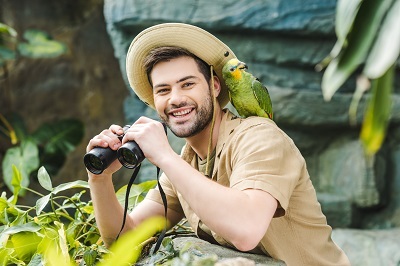
- They are lightweight and easy to carry around.
- Since they are designed for handheld use, they are easier to set up and use.
- They have a wider field of view
- Usable for a wide range of activities including hunting, birding, and watching animals
- Most binoculars are wearable around the neck for easier access.
- They are more comfortable to use because you will be using two eyes to view the objects.
- Less tiring to use as you can use one hand and interchange when the other hand gets tired.
- Binocular vision makes it easier to judge distance and depth.
- Easier to use for beginners
Binoculars Cons
- Binoculars have less magnification power than spotting scopes
- Limited zoom power
Conclusion
As you have seen, binoculars and spotting scopes have very similar applications. The choice of whether to buy binoculars or a spotting scope depends on your specific needs. When looking for the most portable and travel friendly optic device for hunting, birding or watching wildlife, go with binoculars. Looking for the highest magnification for watching objects that are very far, you are best suited with a spotting scope. If your focus is a wider field of view or close focus, a binocular is the best. Finally, you want the best from both worlds, invest in both, starting with binoculars.