Scope Options

Best Microscopes For 2025

Gone are the days when the use of microscopes was restricted to laboratories, mostly in schools, research centers, and hospitals. Modern microscopes are portable, allowing you to carry them outdoors for examining insects, flowers, collectibles, and so on. Moreover, they are inexpensive and easy to use. Even with the tightest of budgets, you can get your hands on this useful equipment.

However, the evolution of microscopes over the years means that the market currently has a myriad of options. For a novice, it might be challenging to find the right choice, but here’s a tip – consider the model that balances between your intended use and the money you wish to spend.

That said, here are some of the standout microscopes currently available in the market.

The Best Microscopes Reviews For 2025

1. Celestron CM800 Compound Microscope

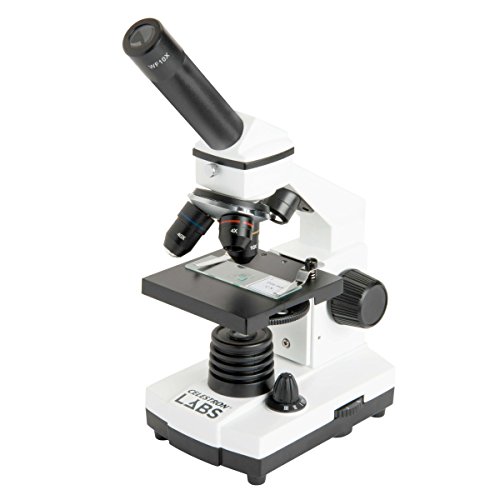
The best thing about the Celestron CM800 Compound Microscope is its suitability for a wide range of applications. Thanks to its broad magnification range and comfortable monocular eyepiece set at 45o, it is well-equipped for school and research labs, as well as for hobbyists.


Concerning lens, the turret located at its mid-point holds three objective lenses, with magnifications of 4x, 10, and 40x. The monocular eyepiece has two lenses that combine to enlarge the object on the stage up to 800x.

With this microscope, the specimen will remain steady throughout the examination, as the stage has clips to hold it in place. Beneath the stage is an adjustable LED emitter that illuminates the specimen for better observation. A US 110 VAC plug powers the LED, but there’s an option to switch to AA batteries in case of an outage or outdoor use.


Another impressive feature of this microscope is its adjustable iris that combines with the condenser to regulate the amount of light illuminating the specimen. Use the focus knob to increase the clarity and sharpness of the sample.

Specifications

  • Type: Compound
  • Magnification Range: 40x, 80x, 100x, 200x, 400x, 800x
  • Eyepieces: WF10x & WF20x
  • Nosepiece: 3 positions
  • Head incline: 45-degree
  • 3AA batteries for outdoor use
  • Upper and bottom adjustable LED illumination
  • Ten prepared slides included

Pros

  • Easy to use focusing knob
  • Supports AC and DC power sources
  • It comes with multiple accessories
  • Adjustable metallic stage

Cons

  • The head is not 360-degree rotatable

2. OMAX 40X-2000X Lab LED Binocular Compound Microscope

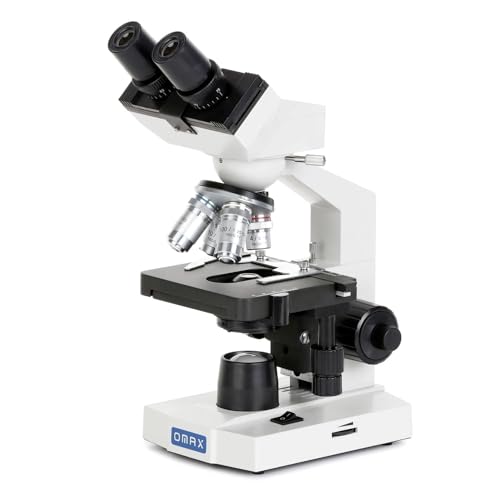
Do you know that some microscopes have moveable stages? One of them is the OMAX 40X-2000X Lab LED Binocular Compound Microscope. On the lower right side of the stage are two knobs that allow you to move the stage in the x and y axes. This allows for better manipulation of the slide, especially if you’re examining live specimens.


The revolving nosepiece has four achromatic objective lenses. The first three have the same magnification rating as most standard units – 4x,10x, and 40x. The fourth has a 100x rating and is most helpful for the oil immersion technique. When combined with lenses in the binocular head, this product can achieve a maximum magnification of 2000x.

This microscope can easily connect to a USB digital camera and transfer the images of your specimen so that you can see them on a larger screen. If need be, you can save them on your computer.

On the downside, it has a single LED illumination system. It’s adjustable using a scroll knob located at the right side of the base, although you have to turn it halfway to start noticing a meaningful amount of light. OMAX fitted an Abbe NA1.25 condenser with an iris diaphragm to focus the beams on the stage.

Features

  • Magnification: 40X – 2000X
  • Objectives: 4X, 10X, 40X, 100X
  • Eyepieces: WF10X and WF20X
  • Nosepiece: quadruple
  • Adjustable LED light
  • Stain-resistant enamel finish
  • AC/DC adapter
  • Coaxial coarse and fine adjustment knobs

Pros

  • Powerful magnification lens
  • Mechanical moveable stage
  • Adjustable led lights
  • Supports AC and DC power sources
  • Compatible with USB cameras

Cons

  • It has one LED light

3. Swift SW350T 40X-2500X Compound Lab Microscope

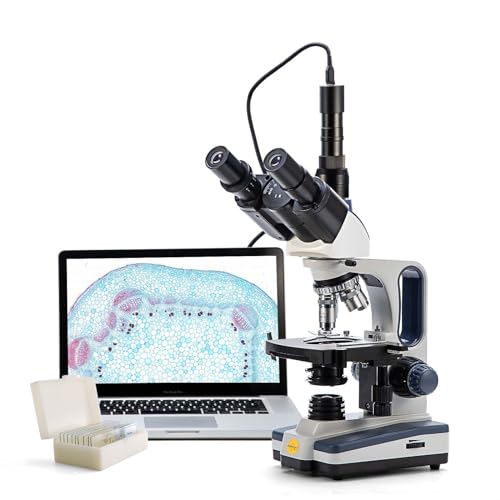
Besides having three eyepieces, this microscope has a swiveling head that allows shared use, making it ideal for high schools and university labs, and research centers. The eyepieces have interchangeable wide-field lenses, rated at 10x and 25x, allowing quick adjustments to suit varying interpupillary distances without losing focus.


On its part, the evolving nose piece has four objective lenses, similar to the OMAX 40x-2000x binocular microscope. An adjustable light bulb illuminates the stage. The beams are focused using the inbuilt NA1.25 Abbe condenser with an iris diaphragm. Below the condenser is a compartment that allows you to insert a blue light filter for better vision.

The third ocular tube doubles as the place for attaching a microscope camera with which you can stream experiments and record them for later viewing. Either side of the arm features a focusing knob, one for coarse adjustments and the other for fine-tuning images.

Features

  • 40X, 100X
  • 360o rotatable trinocular head inclined at 30o
  • Adjustable LED bulb
  • Coaxial coarse and fine adjustment focusing knobs
  • Mechanical stage with a rack stop

Pros

  • Compatible with microscope cameras
  • High-magnification optics system
  • Adjustable LED illumination

Cons

  • It lacks dual LED illumination

4. Emarth’s Microscope For Kids And Beginners

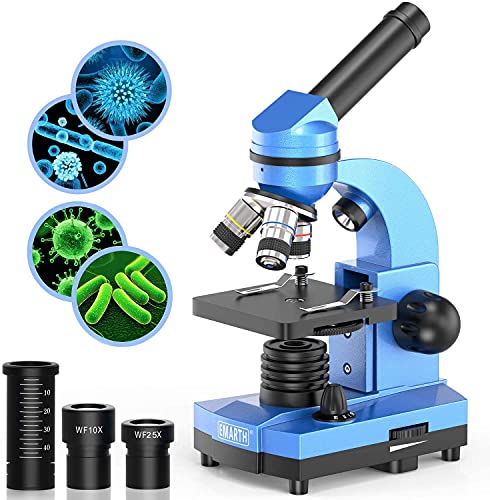
Naturally, kids are curious, and there is no better way to quench their quest to know everything than buying them a microscope. Unlike most models, it has colorful filters, and it’s blue, a striking color that children find eye-catching. It comes with a 52-piece educational kit on how to use it and sample experiments, making it the perfect choice for beginners and kids.


Emarth included dual LED illumination on this unit, one above the stage and the other below. Besides being easy to operate, these LED lights are immune to interference from external light sources. The upper one is ideal for examining opaque objects like coins, while the lower one is useful when observing specimens placed on glass slides.

The revolving nosepiece holds three high-magnification objective lenses rated at 4x, 10x, and 40x. The monocular eyepiece also supports variable magnification, with the lowest being 40x and the highest being 1000x.

You don’t have to stain slides to increase clarity when using this microscope. It comes with a rotating wheel with six colors to save you from this trouble. You can further fine-tune the image using the focus knob

Features

  • Magnification: 40X, 100X, 250X, 400X & 1000X
  • Dual LED illumination
  • Inbuilt six-color filter
  • Educational kit for kids and beginners
  • 360o rotatable monocular head

Pros

  • Metallic base increases stability
  • Adjustable LED illumination
  • High-magnification lenses
  • Easy to use focusing knob

Cons

  • Plastics parts are brittle


5. AmScope M150C-I 40X-1000X Compound Microscope

If you’re looking for a microscope that’s perfect for all types of students, from elementary school to college, the AmScope M150C-I 40X-1000X is a great choice.

Its 360o rotatable monocular head is fixed at 45o, a position that enhances usability by preventing neck strain and allowing you to use it while sitting.


Inside the head are powerful ocular lenses with magnification ranging from 40x to 1000x. Even better, the revolving nose piece has three objective lenses fitted with an aberration-correcting mechanism.

The inbuilt LED illumination system allows you to choose between mains electricity and three AA batteries as the power source. A single-lens condenser located below the stage allows for better focusing of the light beam. However, it’s disappointing that AmScope didn’t include dual-LED illumination like its competitors.


While the absence of an illuminating light above the stage is a disadvantage, the manufacturer somewhat makes up for it by two focusing knobs on either side of the arm. The larger knob offers coarse adjustments, while the smaller one is for fine adjustments. Both are easy to use and highly responsive.

Features

  • Magnification: 40X, 100X, 250X, 400X & 1000X
  • Head: 4-degree Inclined and 360 degrees swivel
  • Eyepiece: WF10X & 25X
  • Illumination: LED
  • Coarse and fine adjustment knobs
  • A fully coated optical system
  • Inbuilt contemporary LED illumination
  • Variable magnification

Pros

  • Easy to use
  • Suitable for students
  • Sharp optics
  • Adjustable light

Cons

  • Lacks dual illumination

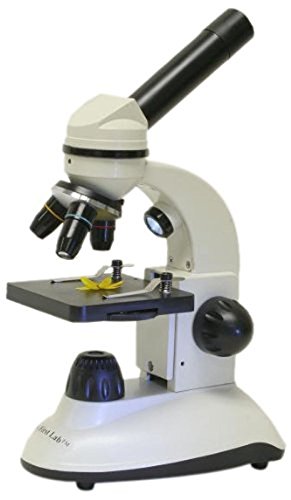
6. My First Lab Duo-Scope Microscope

As the name suggests, the My First Lab Duo-Scope is suitable for beginners, preferably kids below high school.  It’s the perfect gift for a curious child who is showing a keen interest in biology or collectibles.


Equipped with real glass optics, this microscope has a maximum magnification of 400x, which is enough to satisfy any kid’s curiosity.

The nose piece holds three objective lenses rated at 4x, 10x, and 40x, allowing you to use them interchangeably depending on the desired level of detail.

Two light sources, one above and the other one below, illuminate the stage. Because they are LED lights, they’re easy on your batteries.

Additionally, My First Lab includes a 50-piece microscope kit consisting of various accessories and an instruction manual. The manual has useful tips on how to use the microscope. It also contains an experiment guide that spurs further exploration.

Features

  • Magnification: 40x, 100x and 400x
  • A powerful lens with real glass optics
  • One-year manufacturer warranty
  • Kids’ microscope kit

Pros

  • It comes with multiple accessories
  • Easy to set up and use
  • Two light sources

Cons

  • Average magnification power

How To Choose The Perfect Microscope

If you’re planning to purchase a microscope, here are the factors you need to consider.

Compound Microscopes vs. Stereo Microscopes

The two main types of microscopes are compound (high power) and stereo (low power).

Compound microscopes are ideal for examining small specimens like blood samples, bacteria, viruses, etc. This is because such specimens require powerful magnification lenses for a detailed view.

Standard models have between three to five objective lenses with a rating range of 4x to 100x. If you focus on a specimen with a 10x objective and your eyepiece has 25x magnification, the image will be 250 times larger than the sample.
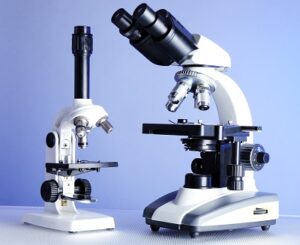
 

Binocular and Trinocular MicroscopesThe most popular variation of compound microscopes are monocular models. These have one eyepiece. That said, you can purchase units with multiple eyepieces, such as binocular and trinocular, which have two and three eyepieces, respectively.

On the other hand, stereo microscopes help examine a large specimen, such as coins, rocks, insects, and so on. This is because they have low magnification power, typically ranging between 6.5x and 45x.


The ability to provide 3D images is the most outstanding feature of stereo microscopes. Also, most of them have two eyepieces.

Stereo microscopes are available in two configurations – dual power and zoom. Models with the dual power configuration have two magnification options, such as 10x and 20x. Zoom microscope has an adjustment function that allows you to set your desired magnification over a specified range, like 6.5x to 40x.

Quality Of Microscope

The quality of a microscope depends on its build design, lenses, and illumination.

Regarding build design, it’s essential to purchase a unit made of robust materials. Besides guaranteeing longevity, high-quality materials provide an ergonomic feel when using the equipment.

Next, you need to consider the quality of the optics system. If you have the money, purchase a unit with achromatic objective lenses since they enhance the sharpness and crispness of images.

The interchangeability of lenses is also a vital factor. To know you can use a lens on multiple microscopes, check if it’s DIN compatible.

Lighting is a crucial aspect of using a microscope. It’s advisable to purchase units with LED bulbs because they are energy-saving and long-lasting. Another option is fluorescent oil, but this is mostly used in high-end equipment.

Other Considerations When Buying A Microscope

When buying a compound microscope, check the type of condenser and iris diaphragm it has. The best in the market is supplied by Abbe, as it allows for greater adjustability. Both items are located above the light and are useful for focusing beams onto the stage.

Another thing you might want to consider is a mechanical stage. This is a useful feature for viewing live specimens at high magnification.

Wrapping Up

A microscope is a valuable piece of equipment if you want to view the world in detail. Nowadays, they are no longer a preserve of students and scientists, but more kids and hobbyists are using them.

While each of the models reviewed in this article has its strengths and weaknesses, the OMAX 40X-2000X Binocular Compound Microscope is the most impressive. It offers premium features like achromatic lenses, DIN compatibility, an Abbe condenser, and support for microscope cameras at a relatively affordable price. What’s more, it supports AC and DC power sources, a characteristic that adds to its versatility.